Without the right team, getting permits for your custom home build can take a long time and feel harder than it should. It can add months and extra fees to the already expensive process of building custom homes. Working with a Maryland home builder who understands your local permit application process is vital.
It is not always the most glamorous part of the job. However, custom luxury homes often have specific and unique features that may require special applications. Working with an experienced team ensures the home building process is as efficient, clear, and comprehensive as possible.
Our award-winning builders break down what permits you may need for your luxury custom home. We cover who should get them and what to expect during the process. Learning what to expect now can save you time, money, and compromises down the line.
Resident New Home Permits: Timelines, Budgets, & What To Expect
The Department of Permitting Services aims to have permits reviewed within 4 weeks of submission. New home permits must be approved by the Department of Permitting Services, the Washington Suburban Sanitary Commission, and the Maryland-National Capital Park and Planning Commission.
The Washington Suburban Sanitary Commission and the Maryland-National Capital Park and Planning Commission are outside agencies. They must complete their review before the permit is issued.
Site work can not begin without the proper permits. All work has to conform to the approved drawings, plans, and documents submitted for permitting.
How Much Should You Budget for Permits for Custom Luxury Homes – Maryland
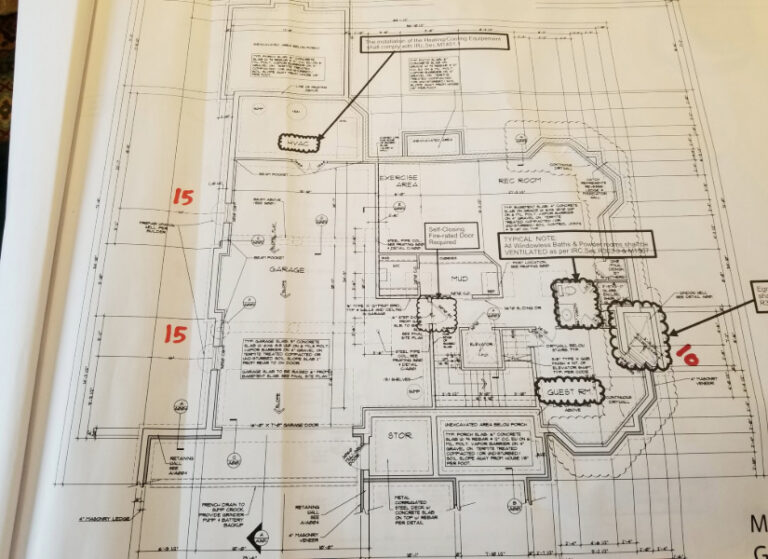
The cost of residential home construction permits depends on your home design. We generally recommend that clients budget $10,000 – $25,000 for their custom luxury homes.
Are impact fees or utility connection fees separate?
The Department of Permitting Services does apply Developmental Impact Taxes. The taxes pay for needed transportation improvements. They also help expand capacity in the nearby public school system.
When you submit a building permit for a new home project, the Transportation and School Impact taxes are automatically applied.
If you are rebuilding a home after demolishing one on the same lot, you may qualify for an impact tax waiver. Utility connection fees are also applied separately in Montgomery County.
What kind of permits might you need for a custom home building project?
Montgomery County requires separate permits for the variety of work needed to build a custom home. Custom home building projects require a variety of permits, including but not necessarily limited to:
Electrical Permits
Residential Mechanical Permits
Public Right of Way Permits
Well Permits
Septic Permits
Fire Protection Permits
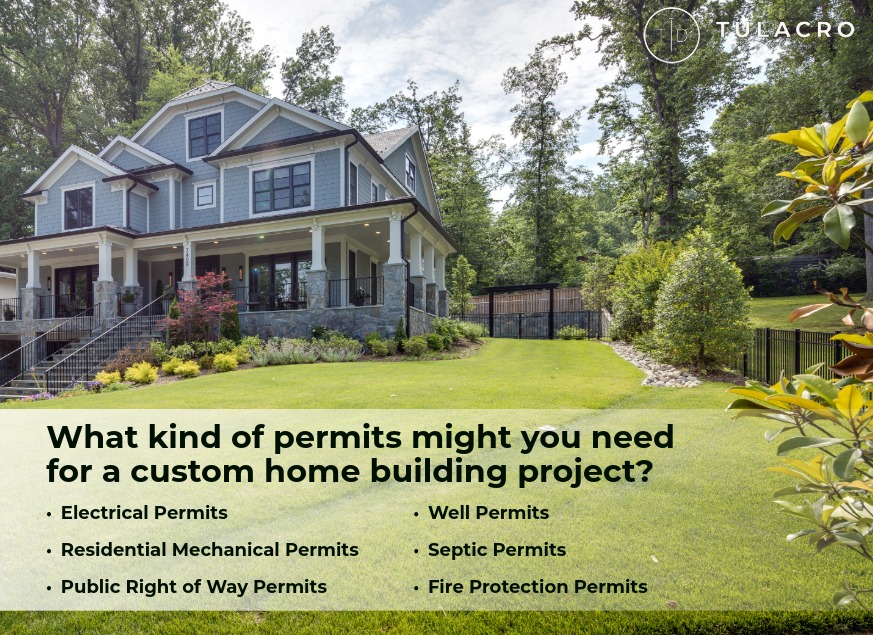
In Bethesda, new home permits are required before building single- and two-family homes and townhomes. They must be no more than three stories high. Residential new homes, single-family homes, and townhouses also need Right-of-Way and Sediment Control permits. These permits are required before construction starts.
Electrical Permits
Site work on the lot cannot begin without electrical permits from Montgomery County to build a custom home. This applies to single-family homes, two-family homes, and townhomes.
Homeowners can not apply for the Electrical Permits themselves unless they take the Homeowner Electrical Exam. They will then be assisted by the Montgomery County Department of Permitting Services Staff to secure the proper permitting.
Homeowners should apply for electrical permits only if they plan to do the work themselves. Otherwise, a Maryland home builder should be the one to apply.
The total cost of Montgomery County electrical permits is the sum of the processing fee and the cost of the items/work. For more details, visit Montgomery County’s Department of Permitting Services’ fee breakdown here.
Electrical permits are automatically issued once the online application is completed and the fees are paid. However, the parent building permit must already be issued. There also can’t be any existing violations on the property before the application is filed.
Residential Mechanical Permits
Mechanical permits are required for any work on heating, ventilation, or air-conditioning systems. This includes building, installing, enlarging, changing, repairing, removing, converting, or replacing the systems.
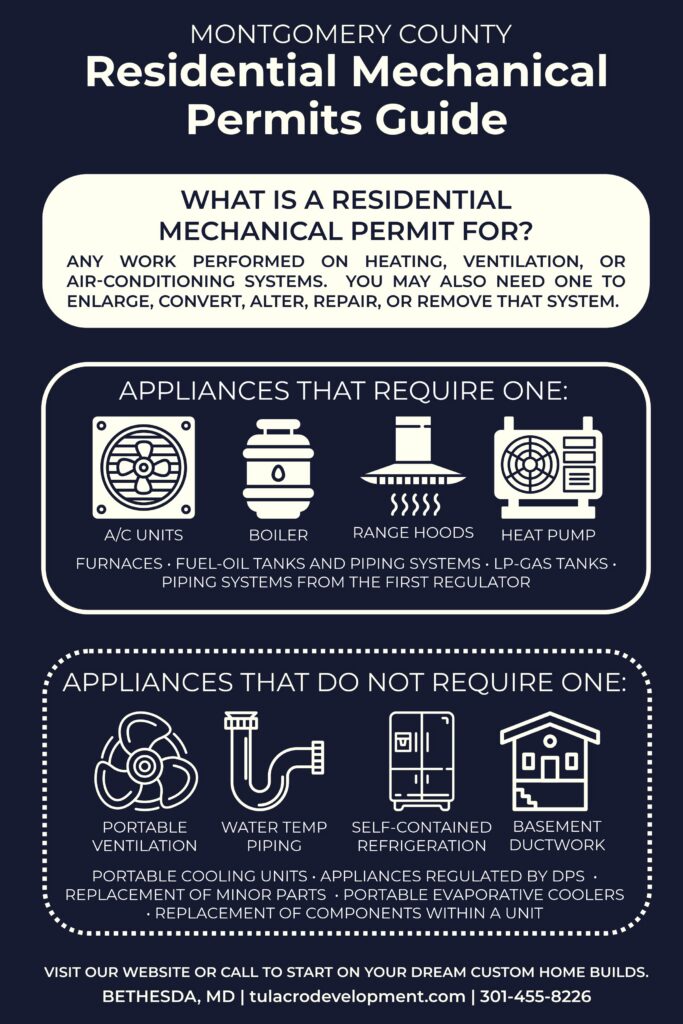
Installation is regulated by the International Mechanical Code (IMC), International Fuel Gas Code (IFGC), or the International Residential Code (IRC). Permits should be pulled for the installation of:
Furnaces.
Heat pumps.
Air-conditioning units.
Range hoods.
Fuel-oil tanks and piping systems.
Boilers with less than 350,000 BTU combined capacity.
LP-gas tanks.
Piping systems from the first regulator.
The Residential Mechanical Permit is not required to start construction. However, you will need it to erect or install a mechanical heating, ventilation, or air-conditioning system when building custom homes. You will also need it to enlarge, alter, repair, remove, convert, or replace that system.
While you must still follow other laws, codes, and rules, you don’t need a Residential Mechanical Permit to add a few specific items. You can add the following to your luxury custom home without a mechanical permit:
Portable ventilation appliances and equipment.
Portable cooling units.
Steam, hot water, or chilled water piping within any heating or cooling equipment or appliances regulated by DPS.
Replacement of any minor part that does not alter the approval of equipment or an appliance or make such equipment or appliance unsafe.
Portable evaporative coolers.
Self-contained refrigeration systems with a maximum rating of 12,000 BTUs.
Finishing single-family basements (attached and detached) where the work is limited to ductwork and exhaust fans.
Replacement of components within a unit such as compressors and/or burners.
Montgomery County’s Department of Permitting Services has listed fees associated with Residential Mechanical Permits here. Applications can be done online. Electronic applications that require plan review generally takes three business days.
Public Right of Way Permits
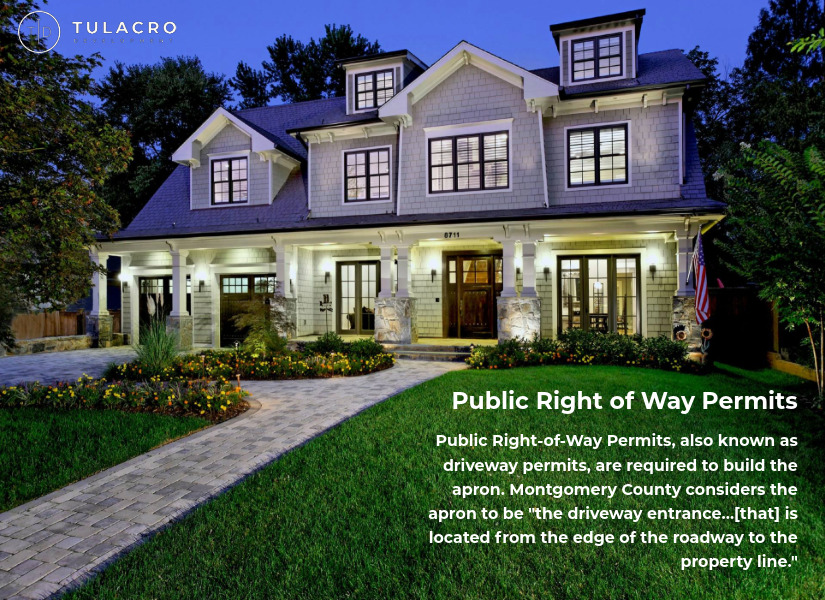
Public Right-of-Way Permits, also known as driveway permits, are required to build the apron. Montgomery County considers the apron to be “the driveway entrance…[that] is located from the edge of the roadway to the property line.”
You will need a driveway permit from Montgomery County if:
The proposed driveway will connect to a Montgomery County roadway.
An existing driveway connects to a Montgomery County roadway, and construction may damage the existing apron. This would be considered a restoration/repair of driveway permit.
If there’s no existing entrance and construction would require access to a Montgomery County roadway.
You won’t need a Montgomery County driveway permit if the proposed driveway connects to a state or municipal roadway. You will need to consult that jurisdiction for more information.
Nothing prevents the homeowner from applying for the permit. However, the permit does have specific requirements. These requirements may make it best for your Maryland home builder team to apply.
According to the Department of Permitting Services, Montgomery County requires a scaled plan at a minimum. This plan must show the proposed driveway location. Additional considerations will be required if the proposed work impacts a tree, is on an arterial road, within the Central Business District, and/or requires a sidewalk closure for more than 15 days.
Public right-of-way permits generally take 2-3 weeks for the Montgomery County Department of Permitting Services to review upon submission.
Well Permits
Well permits allow the creation, replacement, or relocation of any wells drilled in Montgomery County. This includes luxury and custom homes. These permits are required to protect residents and the area’s environment in accordance with County and State standards.
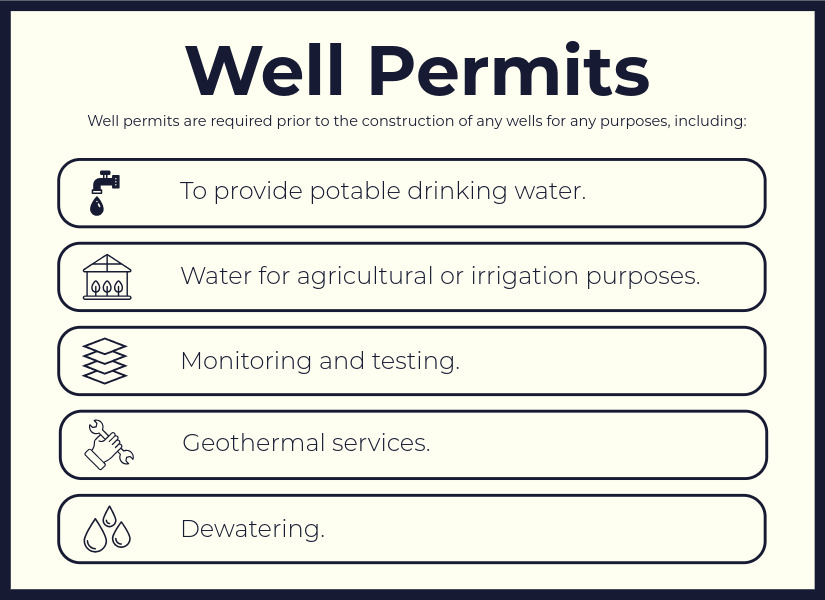
Well permits are required prior to the construction of any wells for any purposes, including:
To provide potable drinking water.
Water for agricultural or irrigation purposes.
Monitoring and testing.
Geothermal services.
Dewatering.
While nothing stops the homeowner from applying for the permit, it has specific requirements. These requirements may make it better for the contractor to apply.
A State Drilling Permit is also required. The licensed well driller must submit the state permit for approval by the Montgomery County Department of Permitting Services.
The cost of well permits is variable, depending on the work being done. To see the full table for fees associated with Well Permits in Montgomery County, click here.
Well permits are generally issued two weeks after the application packet is completed and submitted. Permits for replaceable potable drinking water wells are processed as soon as possible.
Fire Protection Permits
Fire protection permits are for any work involving the installation of fire protection systems. This includes any installations, additions, or modifications. Fire Protection permits are required before systems are installed.
Plans must be submitted and reviewed. Electronic plans must also be reviewed to ensure they meet current codes and standards. Once fees are paid, permits are issued.
The homeowner can not apply for the Fire Protection permit in Montgomery County. It must be a contractor who is licensed with the State of Maryland and the Montgomery County Department of Permitting Services.
Fees associated with the installation of Fire Protection permits in Montgomery County can be found here.
Fire Protection permit turnaround times vary. The Department of Permitting Services aims to return regular permits within two weeks of submission.
Septic Permits
Septic Permits are required for any septic systems installed in Montgomery County. The permits ensure installed systems meet all County and State safety requirements for the environment and residents. There aren’t restrictions preventing homeowners from applying for their own septic permits.
Conclusion
The ideal Maryland home builders make building custom homes easy at every stage of the process, including procuring permits. Filing for the wrong permits or at the wrong time can make an already lengthy process even more complicated. Our goal at Tulacro Development is to be your top Maryland home builder. We aim to make the process easy for you. We set clear expectations and stay transparent. Our years of experience help clients feel confident. They do not have to preoccupy themselves with paperwork details. Instead, we provide them with the ease of mind so they can focus on the features that matter most to them.
Ready to learn more? Reach out to our team and get more information today.